Your Beautiful Homeschool St. Patrick’s Day Guide
Did you guys know, my husband and I met doing mission work in Ireland?!
And in Ireland on St. Patrick’s Day, everything is beautifully green, and there are daffodils growing on the sides of the road!
It is absolutely beautiful.
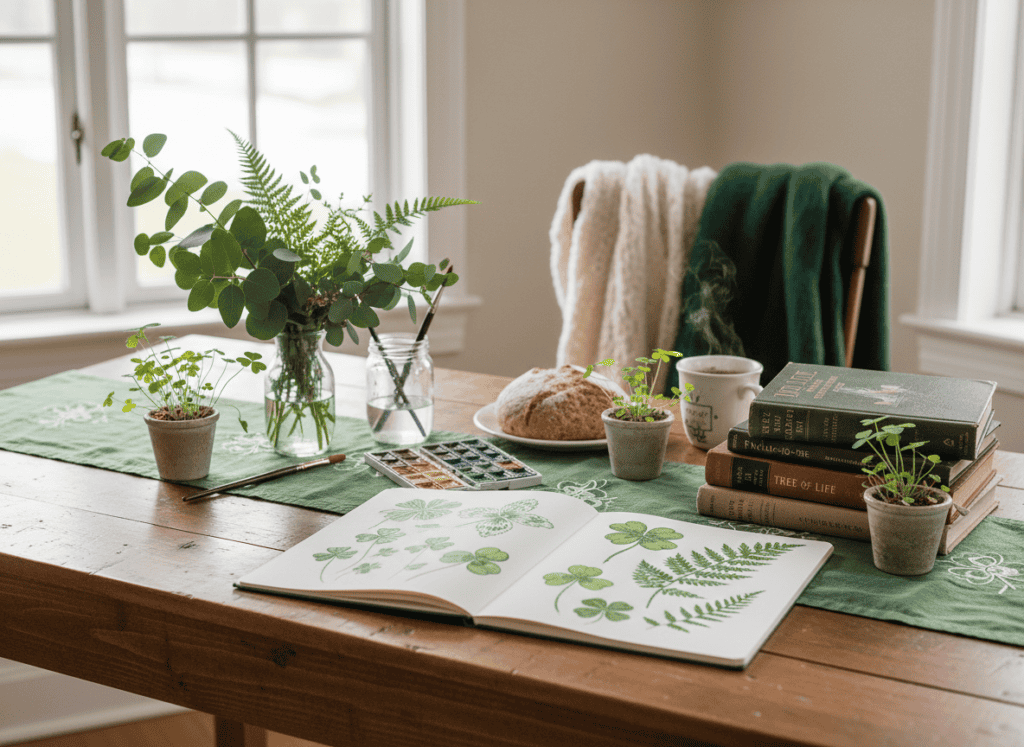
Here, we are in the midst of a late-winter storm, but I am cranking the Irish tunes and getting right in the spirit of it with the kids.
We enjoy St. Patrick’s Day in our home. It can be so much more than green cupcakes and plastic shamrocks. In a Charlotte Mason homeschool, feast days become beautiful opportunities to slow down, learn deeply, and celebrate the lives of real people who shaped history and faith.
The story of Saint Patrick is one of courage, forgiveness, and missionary zeal. His life offers rich material for narration, nature study, art appreciation, music, and meaningful family traditions.
If you’re looking for a gentle, living education approach to the feast day, this guide will help you celebrate St. Patrick’s Day in a way that is joyful, educational, and rooted in the authentic story of Ireland’s beloved saint.
You can also deepen your celebration with our St. Patrick’s Breastplate Prayer Printable and the Into the Deep St. Patrick’s Day Unit Study, which walk children through Patrick’s life, prayers, and the Christian history of Ireland.
Who Was the Real St. Patrick?
The real Saint Patrick was not Irish by birth. He was born in Roman Britain around the late 4th century. As a teenager, he was kidnapped by Irish raiders and enslaved in Ireland, where he worked as a shepherd.
During those lonely years, Patrick turned deeply to prayer. He later wrote that he prayed hundreds of times each day while tending sheep in the hills.
After six years, he escaped and returned home. But the story didn’t end there.
Patrick later felt called by God to return to the very land where he had been enslaved. He went back to Ireland as a missionary and spent decades sharing Christianity throughout the island.
His writings, including the famous Confessio and the prayer often called St. Patrick’s Breastplate, reveal a man of humility, courage, and deep trust in Christ.

Free Tomie de Paola Inspired Colouring Page
St. Patrick Trivia for Kids
These facts are wonderful for narration or morning time discussions:
• Patrick was not originally Irish
• He was enslaved in Ireland for six years
• He worked as a shepherd while in captivity
• Patrick wrote one of the oldest Christian texts from Ireland
• He likely used the shamrock to explain the Trinity
• His feast day, March 17, marks the day he died (or was born into heaven!)
The Early Church in Ireland
Ireland became one of the most vibrant centers of Christian learning in the early Middle Ages.
Monasteries became hubs of scholarship, prayer, and art. Irish monks preserved and copied ancient texts during a time when much of Europe was in turmoil.
Beautiful illuminated manuscripts like the Book of Kells show the incredible craftsmanship of Irish Christian artists.
These monks also traveled across Europe, founding monasteries and spreading Christian learning.
A Charlotte Mason St. Patrick’s Day Nature Walk
Charlotte Mason believed children should spend plenty of time outdoors observing God’s creation. St. Patrick’s Day is the perfect excuse for a nature walk focused on the color green. That is, if you aren’t in the midst of a winter storm, like we are! Count yourselves lucky and go for a stroll for me, ok?
Head outside and see how many shades of green your young children can find.
Nature walk ideas:
- Search for clover and sketch it in a nature journal. You can harvest clover and dry it for tea (especially the flowers of the red clover – the purple ones), or dry them in your flower press and use for cards and art later.
- Look for moss growing on trees or rocks. Recall the difference between moss and lichen.
- Observe early spring buds
- Listen for birds returning in early spring
Encourage children to narrate what they see or draw their favorite discoveries in their nature notebooks.
If it is winter where you live: You can also talk about how Patrick likely spent many quiet hours outdoors while tending sheep in Ireland’s hills. Why not learn about sheep? Or rainbows?
St. Patrick’s Day Map Work
To bring geography into the lesson, locate Ireland on a map and show children where Patrick lived and traveled.
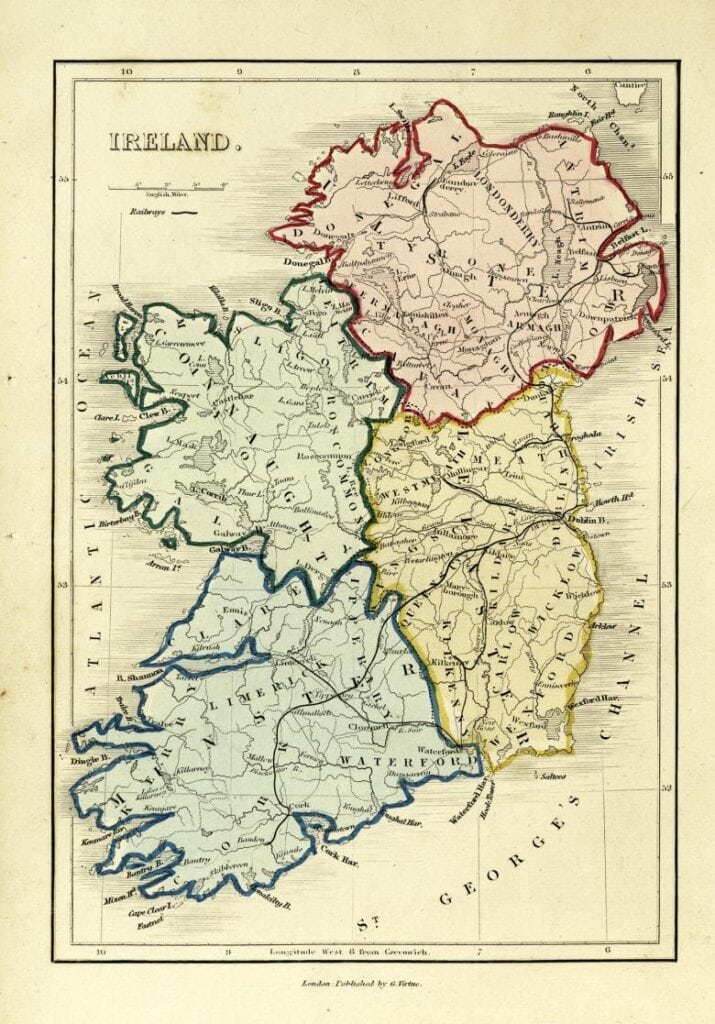
Map of Ireland, from ‘Ireland: Its Scenery, Character, &c.’, 1841-43.
Explore the island of Ireland together and point out historic sites like Croagh Patrick — the mountain where Patrick is said to have fasted and prayed for forty days.
Have your children locate these places on a map:
Ireland: The island nation west of Great Britain where Patrick preached and established Christian communities.
County Mayo: Home to the mountain Croagh Patrick, a famous pilgrimage site where Patrick is said to have fasted and prayed for forty days.
Hill of Tara: An ancient ceremonial site where Patrick is believed to have boldly proclaimed the Christian faith before Irish kings.
Armagh: Considered the ecclesiastical capital of Ireland and closely connected with Patrick’s mission.
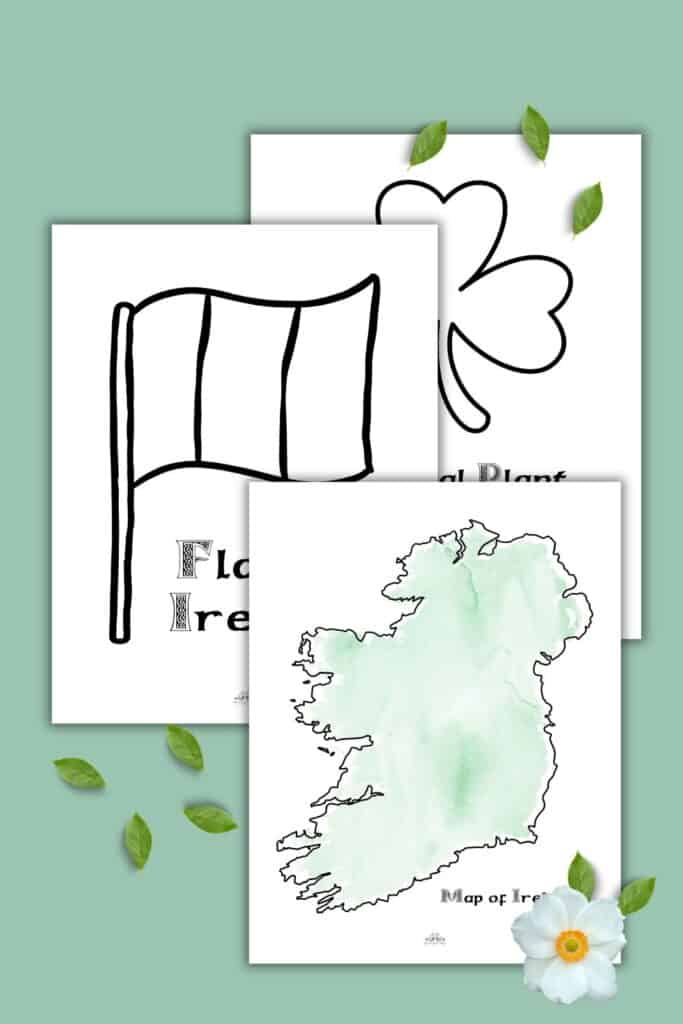
Imagine Patrick’s journey (younger children): I have provided a free printable Ireland map that is already watercoloured green. Young children can add lines and crosses as they imagine where Patrick may have traveled as he preached across Ireland.
Irish Catholic Vocabulary for Kids
Learning a few simple Irish or Catholic phrases can be a fun addition to the day.
Here are a few traditional terms and greetings to introduce:
Shamrock
Irish: Seamróg (SHAM-rog)
Meaning: Little clover
The shamrock became associated with Saint Patrick because he is traditionally said to have used it to explain the mystery of the Holy Trinity.
Trinity
Irish: An Tríonóid Naofa
Meaning: The Holy Trinity
This refers to the three persons of one God: Father, Son, and Holy Spirit.
The Sign of the Cross
Irish: Comhartha na Croise
Children may enjoy learning the prayer in Irish.
In Irish:
In ainm an Athar, agus an Mhic, agus an Spioraid Naoimh. Amen.
In English:
“In the name of the Father, and of the Son, and of the Holy Spirit. Amen.”
God Be With You
Irish: Dia dhuit (DEE-ah gwitch)
Literal meaning: “God be with you.”
Traditional response:
Dia is Muire dhuit — “God and Mary be with you.”
Thank You
Irish: Go raibh maith agat
A helpful phrase children can practice throughout the day.
God
Irish: Dia
This word appears in many traditional Irish greetings and blessings.
Jesus Christ
Irish: Íosa Críost
Holy Spirit
Irish: An Spiorad Naomh
Holy Water
Irish: Uisce beannaithe
Mass
Irish: An Aifreann
The Catholic Mass has been central to Irish Christian life for centuries.
Rosary
Irish: An Choróin Mhuire
Meaning: “Mary’s Crown.”
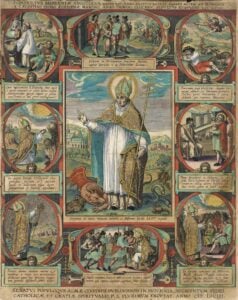
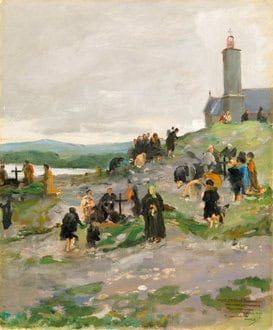
Beautiful Art to Explore
Visit the website of the National Gallery of Ireland to explore these images.
Scenes from the Life of Saint Patrick Adriaen Collaert, Flemish, 1560-1618
Saint Patrick’s Purgatory John Lavery, Irish, 1856-1941
Hands-on Art Ideas:
- Paint your own Irish countryside scene
- Watch a video about the Book of Kells
- Examine the Book of Kells online
- Try creating illuminated letters inspired by the Book of Kells: illuminated letters tutorial
- Draw a Celtic knot with Art for Kids Hub
Music for a St. Patrick’s Day Morning Time
Traditional Irish music is lively, joyful, and perfect for a feast day celebration.
Introduce children to instruments like the fiddle, tin whistle, and bodhrán drum.
Ideas for music study:
• Listen to traditional Irish folk tunes
• Try simple Irish step dancing together
• Learn a traditional Irish blessing
• Sing a hymn connected to St Patrick
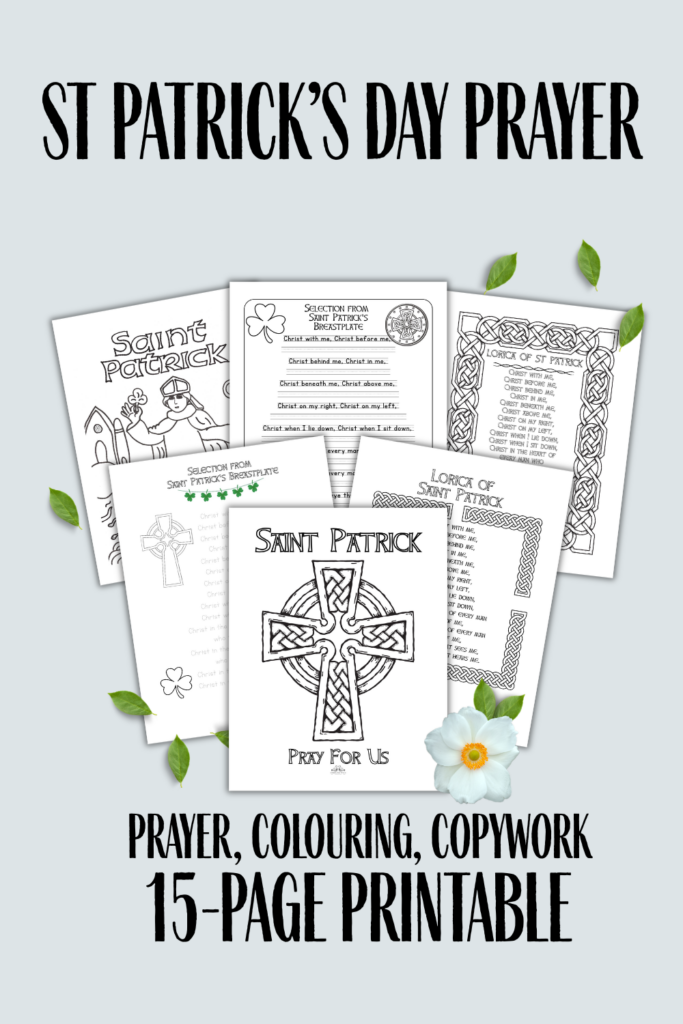
One beautiful prayer to read together is St. Patrick’s Breastplate, sometimes called The Lorica of St. Patrick. You can print our St. Patrick’s Breastplate Prayer Printable and recite it during morning time.
Picture Books About St. Patrick
Living books bring history to life far better than textbooks.
Here are wonderful picture books for learning about Patrick and Ireland:
- Stories of the Saints by Carey Wallace
- Patrick: Patron Saint of Ireland by Tomie dePaola
- Saint Patrick and the Peddler by Margaret Hodges
Teens and Adults: The Confession of Saint Patrick
After reading, ask children to narrate the story in their own words — a classic Charlotte Mason technique that strengthens comprehension and memory.
A “Catch a Leprechaun” STEM Challenge – Handicrafts??
While leprechauns are part of Irish folklore rather than Christian history, they can still provide a fun creative challenge. Ever since my time working as a children’s librarian, we have done STEM leprechaun catching.
Based off the picture book “How to Catch a Leprechaun,” invite children to design and build a trap to catch a leprechaun. My kids usually use recycle, craft paper, and lots of imagination.
Possible materials:
- cardboard boxes
- craft sticks
- string
- coins, trinkets
- paper tubes
- tape and glue
Challenge questions:
• What will lure the leprechaun into the trap?
• How will the trap close?
• What materials are strongest?
Encourage children to sketch their design first, then build and test it.
Authentic Irish Food to Make Together
Cooking together is a wonderful way to celebrate a feast day. We are making lots of soda bread today for a St. Paddy’s day celebration with friends.
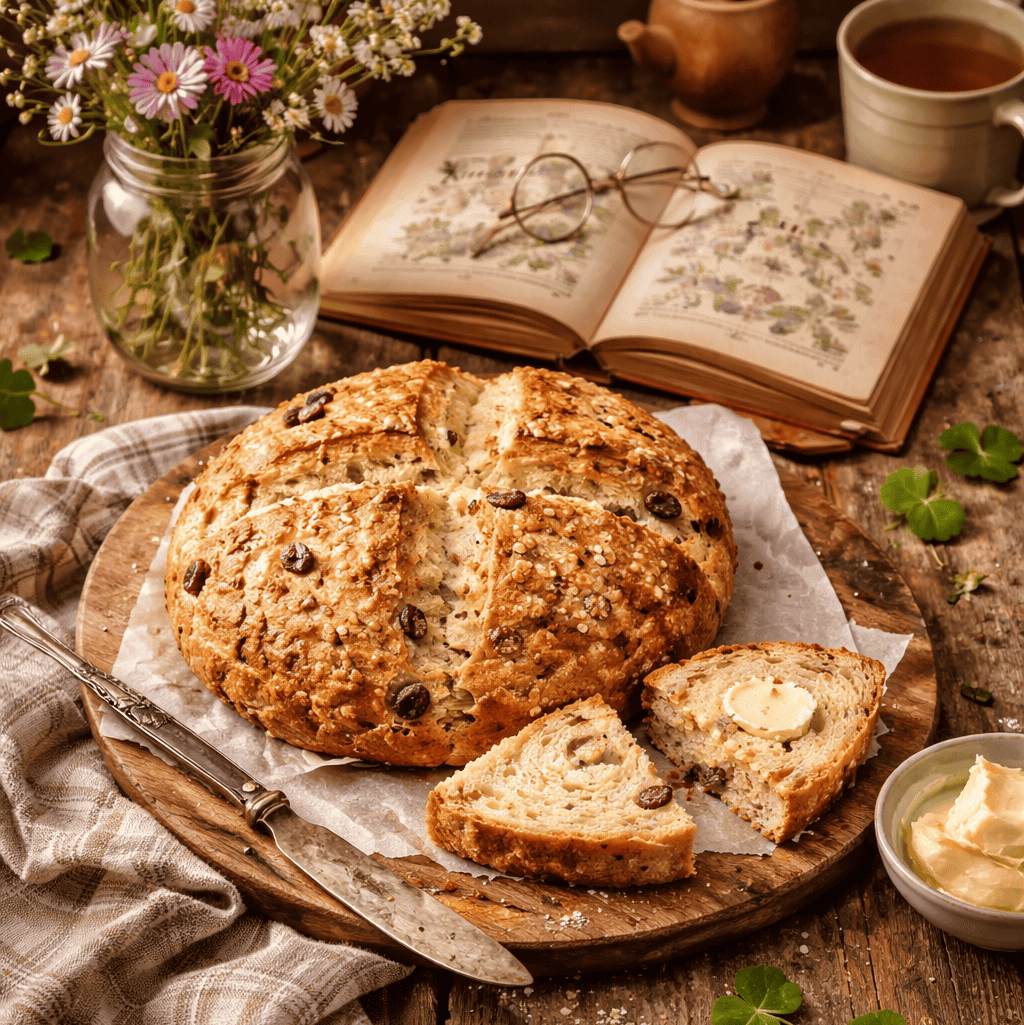
Start with traditional Irish soda bread. This simple bread uses baking soda instead of yeast and has been a staple in Irish homes for generations.
Serve it warm with butter or jam.
Other authentic Irish dishes to try:
- Irish stew with lamb, potatoes, and carrots
- Colcannon (mashed potatoes with cabbage or kale)
- Shepherd’s pie
- Brown soda bread
- If you don’t have time or patience for these, have tea and biscuits!
The History of the Irish Flag
The national flag of Ireland is a vertical tricolour made up of green, white, and orange stripes of equal width.
The flag was first introduced in 1848 by Irish nationalists during a period of political movements across Europe. It was presented publicly by Thomas Francis Meagher, an Irish nationalist leader who was inspired by the French tricolour flag and its symbolism of liberty.
Colours:
Green had long been associated with Irish nationalism and the Gaelic tradition of Ireland.
Orange represented supporters of the Protestant leader William of Orange, whose followers were historically prominent in parts of Ireland.
White, placed between the two colors, symbolized the hope for peace and unity between these communities.
Although the flag was introduced in 1848, it was not widely used at first. It became more prominent during the early 20th century, particularly during the Easter Rising.
When the Irish Free State was established in 1922, the green-white-orange tricolour continued to be used as the national flag. It was later formally recognized in the Constitution of Ireland in 1937.
Today, the Irish tricolour is one of the most recognizable national symbols of Ireland and represents the country’s history and the ideal of peace between different traditions within the nation.
A Simple St. Patrick’s Day Schedule
If you want a gentle flow for the day, here is a simple Charlotte Mason–style rhythm.
Morning Time
Read a picture book about Saint Patrick
Pray St. Patrick’s Breastplate
Listen to Irish music
Mid-Morning
Nature walk searching for shades of green
Sketch clover in nature journals
Late Morning
Art study
Create Celtic knot artwork
Afternoon
STEM “Catch a Leprechaun” challenge
Crafts or illuminated lettering
Dinner
Serve Irish soda bread and Irish stew
Evening
Listen to the Rosary in Irish
End the evening with an Irish blessing or hymn.
Going Deeper with Your Homeschool
If you want a richer study of Ireland and the life of Patrick, check out Into the Deep St. Patrick’s Day Unit Study.
And be sure to grab my free St. Patrick’s Breastplate Prayer Printable.
A Feast Day Worth Celebrating
St. Patrick’s Day becomes far more meaningful when we remember the real story behind it.
The life of Saint Patrick reminds us that God can use even hardship for great good. A young enslaved shepherd eventually became one of the most beloved missionaries in Christian history. Children will enjoy learning about this amazing historic hero.
Check out these Catholic devotions!
This post may contain affiliate links. See my full disclosure here.
Pin this post for later!
If you liked this post, please consider sharing it with a friend or pinning to Pinterest so others can find it and enjoy it!
Check out some of my recent posts: